Timeline of Events
1. 25th July 2014 - Assault
Caerwyn Ash’s first encounter with South Wales police was the life changing assault by Emma Calved on the 25th July 2014, reported to PC Smith (SWP 5097), who found Caerwyn Ash in a pool of blood in his 33 Kilvey terrace home.
Two police officers stood over Caerwyn Ash adjacent to two paramedics who had just arrived. The first words from PC Smith (SWP 5097) was “what did you do to her” while laughing.
The Caerwyn Ash spent the night in hospital receiving rhinoplasty surgery to correct damaged nasal cartilage.
PC Smith and colleague were given Emma Calved’s mobile Phone number and the address in Newport where she was heading (17 Goodrich Crescent, Newport, NP20 5PE). PC Smiths colleague called Emma Calved whilst she was driving away from the scene. PC Smith (SWP 5097) refused to investigate as its one person’s word against another and it’s just too much paperwork.
The paramedics made a comment that is ingrained in my memory when in the back of the ambulance “the police don’t get involved unless it’s a women being hit”
[Offences against the Person Act, (1861), S20, S47]
At the time I didn’t feel anything, I was in shock and nauseous from regaining consciousness. The paramedics were kind and, the two police officers did not give a fuck just had a laugh at my expense. Only after getting home from the hospital did I realises the unprofessional conduct of the officers I can only image that if I was female in a dress covered in blood they probably would have taken the assault seriously. Had these two officers investigated Emma Calved would not have been able to travel from Newport to Swansea and removed high valued items from Caerwyn Ash’s House with the intent to blackmail.

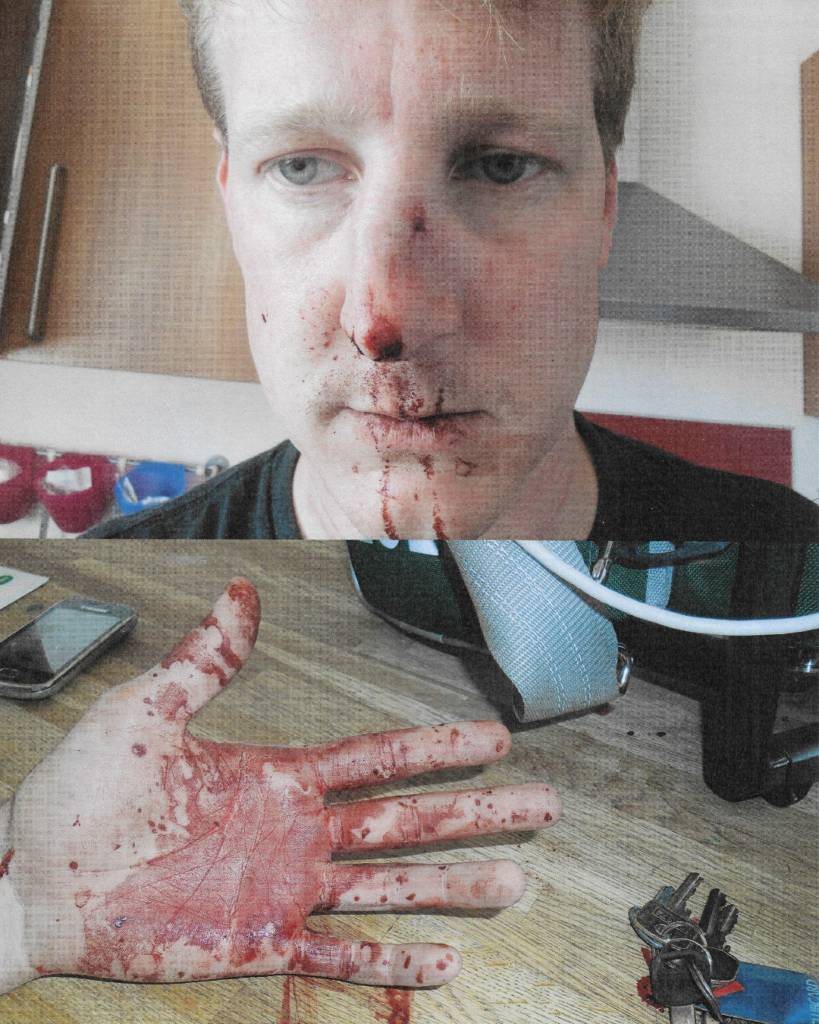
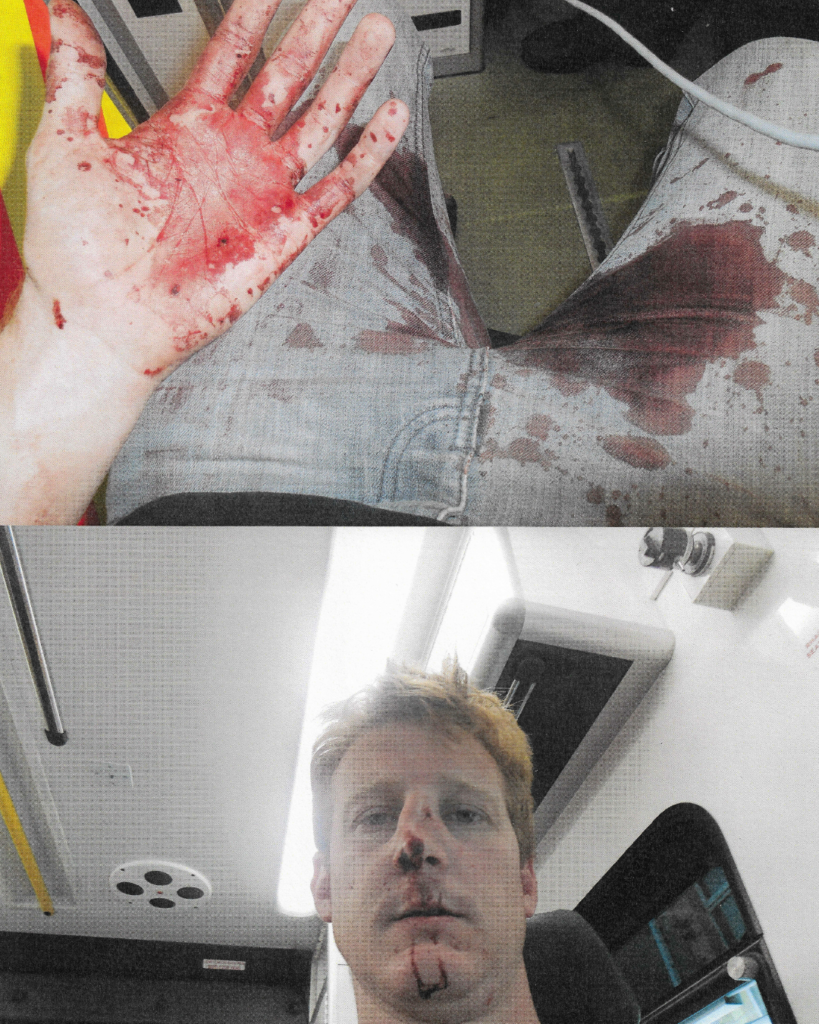
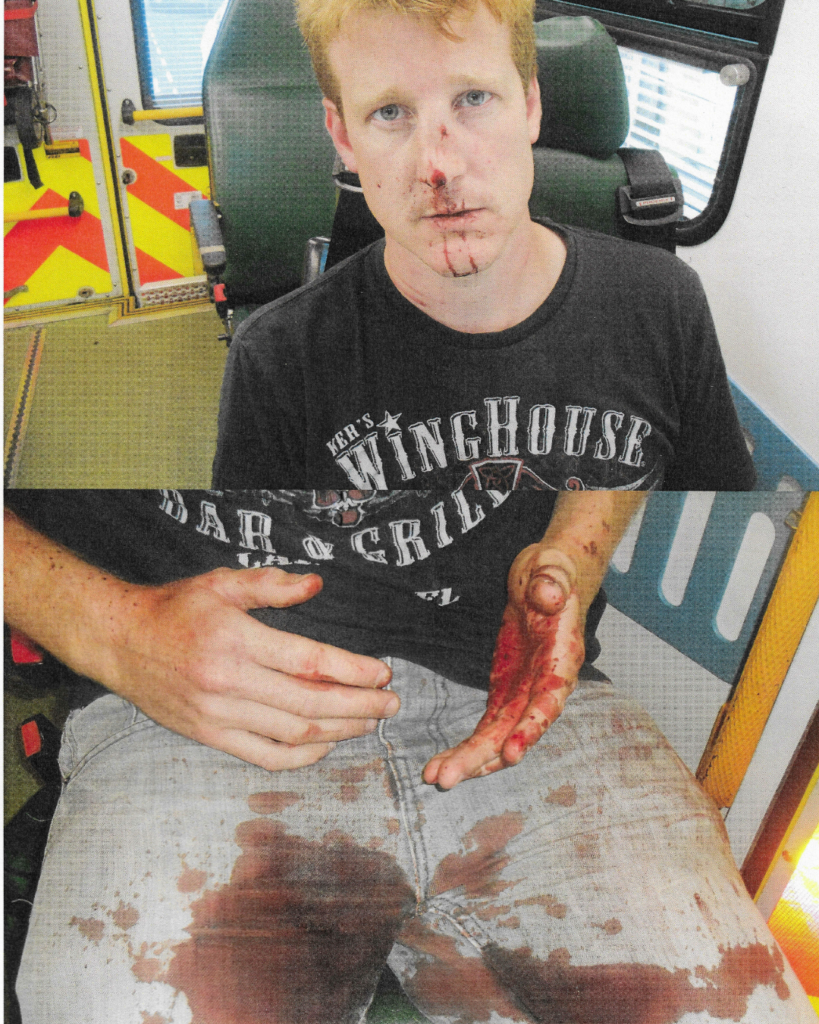
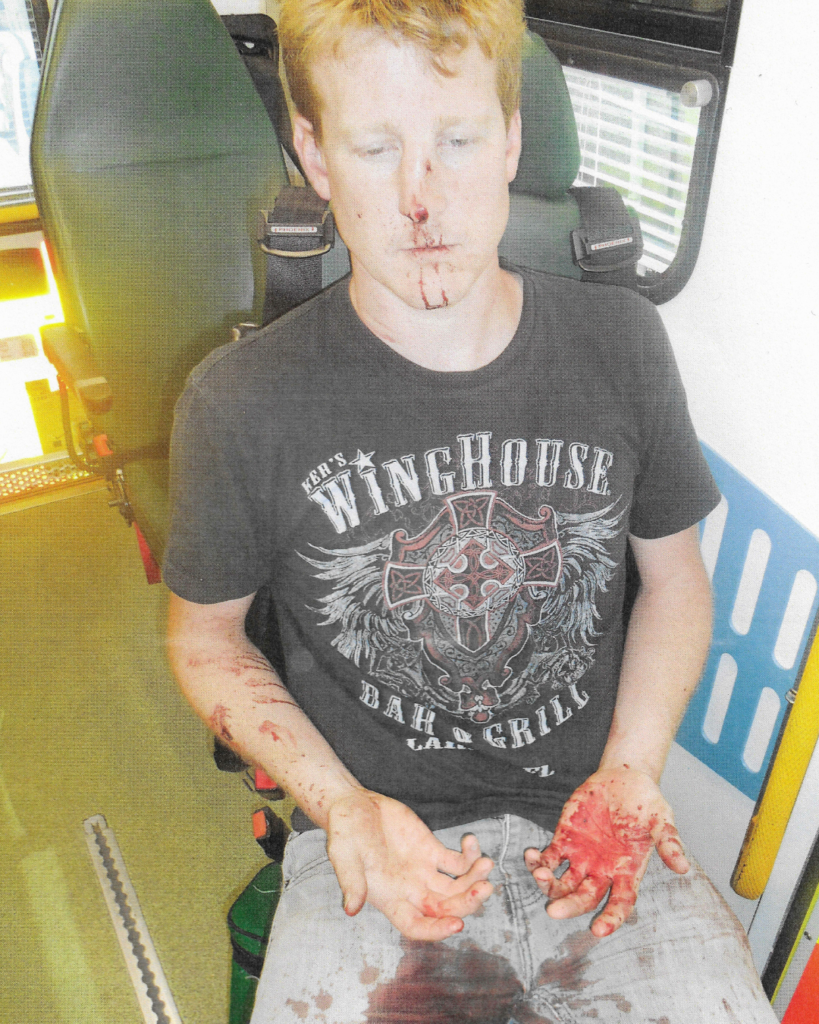
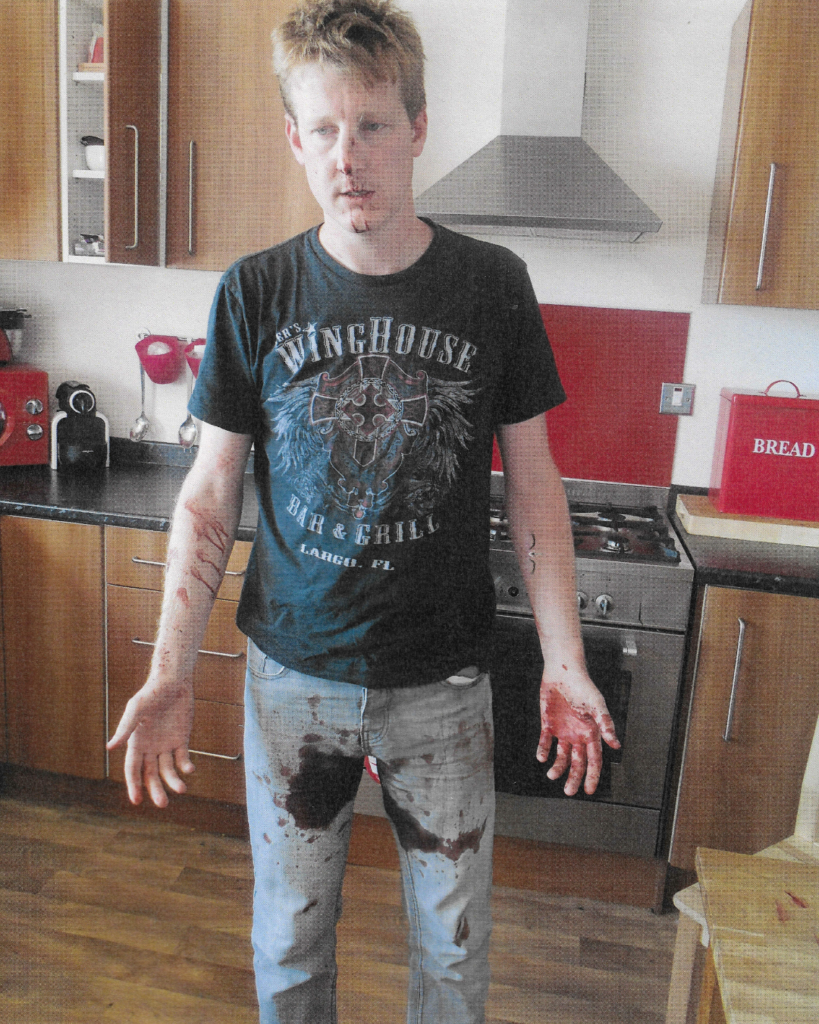
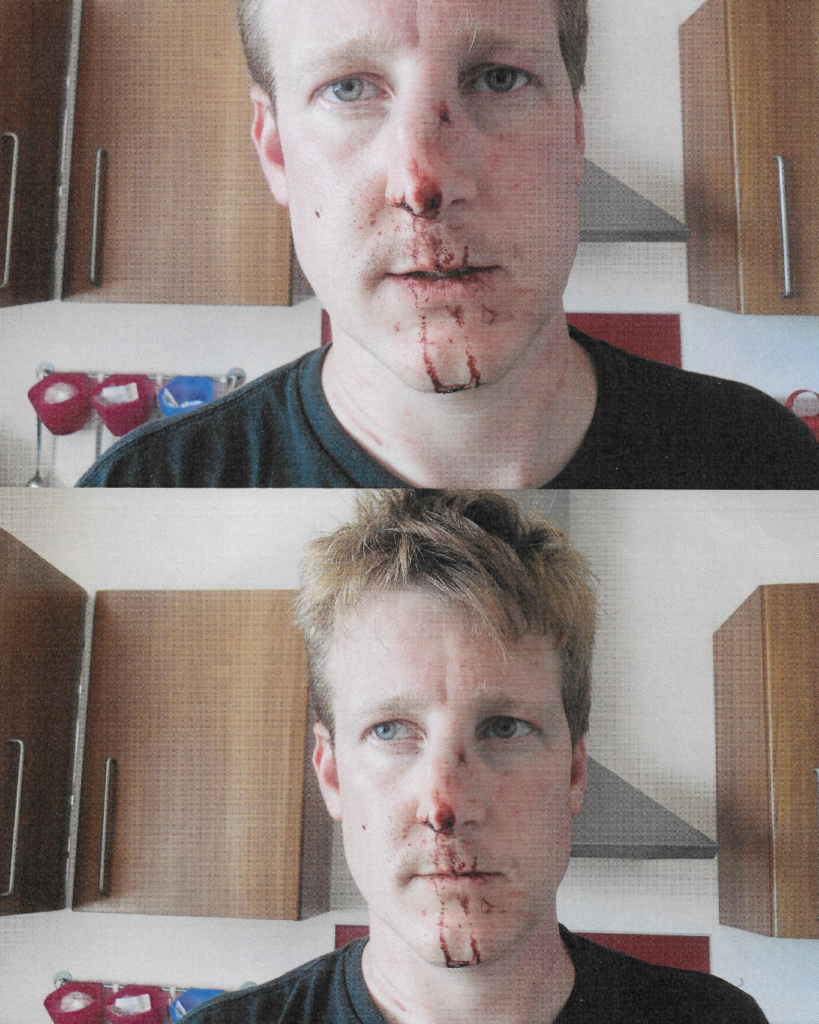
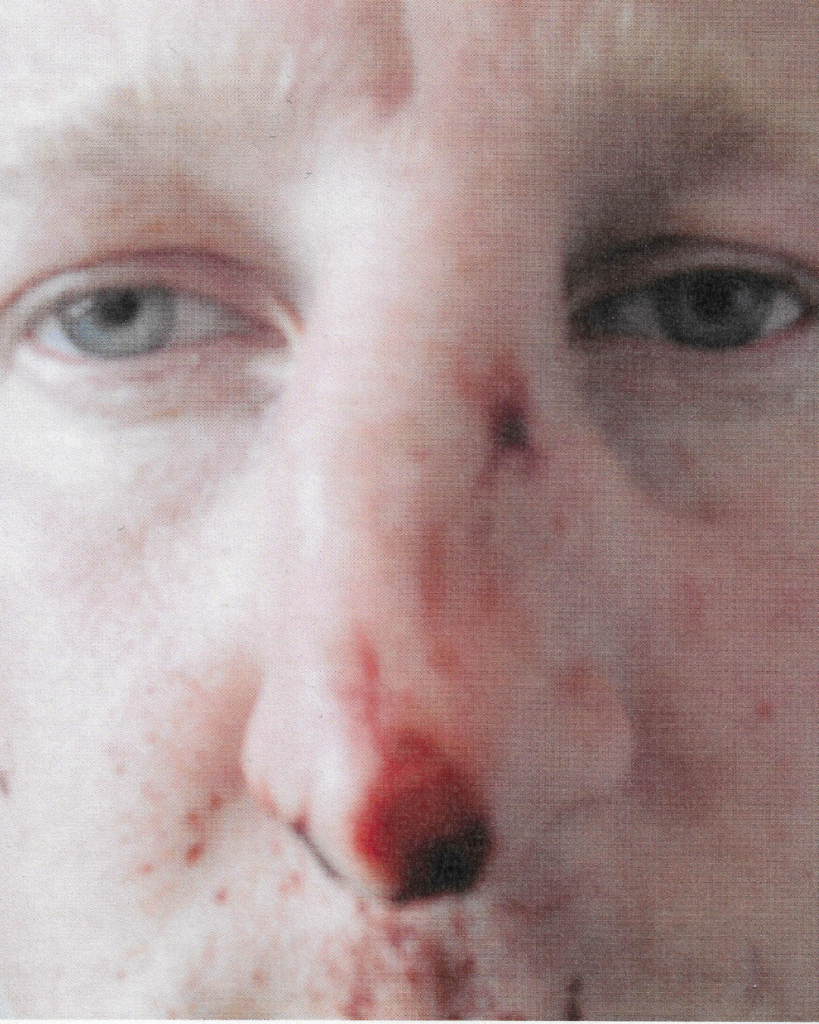
These photographs were taken by paramedics after I reported an assault by Emma Calved, which resulted in a broken nose and a loss of consciousness. Despite the severity of my injuries, PC Smith (SWP 5097) and his colleague failed to properly investigate the assault. My first interaction with South Wales Police left me feeling dehumanised and humiliated. Rather than being treated as a victim of a serious assault, I felt that my injuries and circumstances were not taken seriously. At a time when I was visibly injured and covered in blood, the attending officers appeared uninterested in providing assistance or conducting a thorough investigation.
Subsequently, PC Smith informed both the Professional Standards Department (PSD) and the Independent Office for Police Conduct (IOPC) that I, Caerwyn Ash, had been uncooperative and had refused to be photographed. This account is contradicted by the existence of these photographs, which were taken at the time of the incident and clearly document my injuries. In my view, this raises serious concerns regarding the accuracy and honesty of the information provided to the PSD and IOPC.

2. 26-27th July 2014 – Theft and Blackmail
Whilst I was undergoing further rhinoplasty surgery on 26 and 27 July 2014, Emma Calved travelled from Newport to Swansea and entered my property using a key that had been left with a neighbour. During this period, a substantial quantity of equipment, cash, electronic devices and data belonging to me and third parties was removed from the property without my consent.
Following this incident, Emma Calved sent messages threatening to destroy the equipment if I reported the assault that had occurred on 25 July 2014. Specifically, she threatened to smash the equipment with a hammer should I contact the police.
The matter was reported immediately to PC Whomes (SWP 5437). During our meeting, I provided receipts demonstrating ownership of the stolen items, together with mortgage deeds confirming my ownership of the property. PC Whomes was also shown and provided with copies of the threatening messages, together with photographs documenting the injuries I sustained during the assault on 25 July 2014.
I further informed PC Whomes that some of the equipment and data belonged to L’Oréal Paris and Dezac Ltd and contained human clinical study data. The significance and potential sensitivity of this material were explained to him at the time.
Section 9 of the Theft Act 1968 states:
“A person is guilty of burglary if, having entered any building or part of a building as a trespasser, they steal or attempt to steal anything in the building or inflict or attempt to inflict grievous bodily harm on any person therein.”
More than a decade later, the theft and associated allegations remain unresolved. In my view, the removal of the property on 26–27 July 2014 was closely connected to the assault that occurred on 25 July 2014 and the subsequent threats made to prevent me from reporting that assault to the police.
Among the items removed were:
• Toshiba laptop computers and hard drives
• L’Oréal laptop computer and hard drive
• More than £1,000 in cash
• Three bottles of boutique whisky
• Multiple iPads
During my interactions with PC Whomes, I formed the impression that the matter was not treated with the urgency warranted by the seriousness of the allegations. Despite being provided with evidence relating to the assault, theft, and threatening messages, I was instructed to attend Swansea Central Police Station separately to report the assault because PC Whomes stated that he was occupied dealing with the theft investigation.
That afternoon, I attended Swansea Central Police Station and formally reported the assault, providing printed photographs of the injuries I had sustained.
Approximately one week later, I encountered PC Whomes on Pentreguinea Road and asked for an update regarding the stolen property. He informed me that, because Emma Calved resided in Newport, officers from Gwent Police would be responsible for recovering the items.
Relevant legislation:
• Theft Act 1968, Sections 1 and 9
• Theft Act 1968, Section 21 (Blackmail)
• Criminal Justice Act 2003, Section 329
3. 26th - 27th July 2014 – Blackmail of Threat to Damage Stolen Items
On the afternoon of 26–27 July 2014, I returned to my home at 33 Kilvey Terrace, St Thomas, Swansea, following treatment at Singleton Hospital. Upon arriving home, I received text messages from Emma Calved. The messages indicated that she had travelled from Newport to Swansea, entered my property, and removed a number of high-value items.
The messages also contained threats to destroy the property if I reported the assault that had occurred on 25 July 2014. Among the items removed were devices and data belonging to L’Oréal Paris, for which I was undertaking paid work. The threatened destruction of this equipment and data caused me significant concern, particularly given its commercial value and the sensitive nature of the information it contained.
For a considerable period, I had been subjected to threats and intimidation from Emma Calved. As a result, I experienced significant anxiety and distress when deciding whether to report these matters to the police. Nevertheless, I placed my trust in South Wales Police and reported the incident to PC Whomes (SWP 5437), believing that the allegations would be properly investigated.
More than ten years later, the property has still not been recovered. The loss of these items, together with the lack of resolution, has caused ongoing financial loss and psychological distress.
I acted promptly and responsibly by contacting the police immediately after discovering the theft and receiving the threatening messages. I remained at the property and waited for officers to attend. When PC Whomes arrived, I provided details of the theft, the threatening messages, and the circumstances surrounding the incident. However, I was left with the impression that the seriousness of the matter and its impact upon me were not fully appreciated, despite the significant value of the property involved and the threats that had been made.
5. 28th July 2014 – Emma Called Gwent Police
Following these events, Emma Calved contacted the police and enquired whether a formal complaint had been made against her.
Police Staff Giess (GWP 55951) informed her that Caerwyn Ash had been uncooperative and that no details had been taken. This information was incorrect and appears inconsistent with the information that had already been provided to South Wales Police.
On 25 July 2014, I provided PC Smith (SWP 5097) with Emma Calved’s telephone number and home address in Newport. I was also aware that PC Smith’s colleague contacted Emma Calved by telephone whilst she was travelling back to Newport following the assault.
Following my discharge from hospital, I returned home to discover that Emma Calved had travelled from Newport to Swansea, entered my property, removed equipment required for my work with L’Oréal, and taken devices containing human data. I also received text messages threatening to destroy the equipment with a hammer if I reported the assault to the police.
I immediately reported the theft and the threatening messages to PC Whomes (SWP 5437) on 26–27 July 2014. These matters should therefore have been recorded on police systems. On the advice of PC Whomes, I also attended Swansea Central Police Station on 27 July 2014 and formally reported the assault, providing photographs of my injuries. This report should likewise have been recorded on police systems.
Given these prior reports and the information already supplied to officers, I am unable to understand how Emma Calved could have been informed that I had been uncooperative and that no details had been taken. This statement appears inconsistent with the documented interactions I had with South Wales Police, during which I provided evidence, witness information, photographs, contact details, and details of the alleged offences.
I am deeply concerned that inaccurate information was communicated to Emma Calved. In my view, this undermined confidence in the police response to my reports and may have created the impression that no meaningful action would be taken in relation to the allegations of assault, theft, and threatening behaviour.
Having reported these serious and life-changing events on multiple occasions, I remain profoundly disappointed by the handling of the matter and by the apparent failures in communication and record-keeping between the officers involved.
6. August 2014 – Blackmail for Household Goods
Emma Calved subsequently sent further messages threatening to destroy the L’Oréal laptop unless I provided her with money and surrendered household items from my property. The communications also threatened that I would lose contact with my children if I failed to comply with her demands.
Despite having already reported the unlawful entry and removal of property to PC Whomes (SWP 5437) on 27 July 2014, I provided him with copies of these additional text messages and email communications. These messages demonstrated that the threats were continuing and that the property remained in Emma Calved’s possession. Despite being provided with this evidence, I saw no effective action taken in response.
Faced with the prospect of losing contact with my children, I felt under considerable pressure to comply with Emma Calved’s demands. At the time, I had little confidence that the police would intervene effectively, given my previous experiences in reporting the assault, theft, and threatening communications. As a result, I reluctantly acceded to a number of her demands in order to preserve my relationship with my children.
This evidence was subsequently provided to PC Rhys Williams (SWP 5963) at Morriston Police Station on 16 May 2018. PC Williams was given copies of the threatening and blackmailing messages, which indicated that Emma Calved remained in possession of the L’Oréal laptop and associated hard drive. According to PC Williams’ subsequent courtroom testimony, he shared this information with PC Laura Murphy (GWP 1794), together with evidence relating to the false impersonation of minors reported on 12 May 2018.
In my view, these communications provided further evidence of ongoing coercive and controlling behaviour, as well as the continued retention of property that had been reported stolen years earlier.
The consequences for me were significant. I felt compelled to make decisions against my own financial interests because of the fear of losing contact with my children. This had a substantial emotional and financial impact on my life and contributed to a prolonged period of distress and hardship.
Relevant legislation:
- Theft Act 1968, Section 21 (Blackmail)
• Malicious Communications Act 1988
7. November 2014 – New L’Oreal laptop
In the months following the assault, theft, and threatening communications, I was left living in a largely empty house and experiencing significant financial hardship. Many of the items removed from my property had not been recovered, and I remained without equipment necessary to continue my professional work.
As a consequence, I was required to travel to Paris to obtain a replacement laptop and hard drive from L’Oréal in order to complete the analysis of a high-value human data study for which I was responsible. This caused considerable disruption to both my professional and personal life, together with additional financial and emotional strain at an already difficult time.
In my view, these circumstances were exacerbated by the failure to effectively investigate the reported offences, recover the stolen property, or take action in response to the continuing threats and blackmail that I had reported to South Wales Police. Despite providing evidence of the theft, the threatening communications, and the location of the individual concerned, the matter remained unresolved and the property was not recovered.
The lasting impact of these events has been substantial, affecting my financial position, professional obligations, and overall wellbeing for many years thereafter.
8. 12th August 2015 – Phone Calls to Employer
In May 2015, I was appointed Professor of Medical Devices. On 12 August 2015, I was informed by my university’s Human Resources Department that they had received an abusive telephone call from Emma Calved via the university switchboard.
That same afternoon, I attended Swansea Central Police Station and provided PC Ball (SWP 4639) with a formal written statement concerning the incident (pages 9004–9005). In this statement, I explained the distress caused by the abusive communication being directed to my workplace. I also provided Emma Calved’s mobile telephone number and home address and requested that the matter be investigated.
During this meeting, I informed PC Ball of the assault that had occurred in July 2014 and showed him photographs of the injuries I had sustained. I also explained that the theft of high-value property reported in July 2014 remained unresolved and that there had been numerous further incidents of malicious communications which had caused ongoing emotional distress.
A copy of this statement was subsequently provided to PC Rhys Williams (SWP 5963) and appears at pages 957–958 of Appendix B. According to PC Williams’ oral testimony at trial, this information was later shared with PC Laura Murphy (GWP 1794) following their meeting on 16 May 2018.
The communication directed towards my employer represented a significant intrusion into my professional life. At the time, I had been in post as a Professor for only three months. The incident involved my colleagues and workplace in matters that should never have affected them and caused me considerable embarrassment, anxiety, and concern regarding my professional reputation.
I acted promptly and responsibly by reporting the matter to South Wales Police in a formal written statement and by providing identifying information relating to Emma Calved. Given the history of previous reports concerning assault, theft, threatening behaviour, and malicious communications, I was disappointed that the matter appeared to be treated as a jurisdictional issue rather than as part of an ongoing pattern of conduct that had already been repeatedly reported to the police.
Relevant legislation:
• Malicious Communications Act 1988
• Communications Act 2003, Section 127
• Protection from Harassment Act 1997, Sections 2A and 4A
• Serious Crime Act 2015, Section 76
The cumulative effect of these incidents was significant. The intrusion into my professional life, the involvement of my colleagues, and the continuing pattern of unwanted communications caused substantial emotional distress and had a lasting impact on my wellbeing and sense of security.
9. 16th September 2015 – Phone Calls to Employer
On 16 September 2015, I attended Swansea Central Police Station and reported further incidents to PC Ball (SWP 4639).
Despite my previous report in August 2015, Emma Calved had continued to contact my employer. I was informed that she had made further abusive telephone calls to the University’s Human Resources Department, including enquiries regarding my salary and other personal employment matters. These communications were unwanted, intrusive, and formed part of a continuing pattern of conduct that I had previously reported to South Wales Police.
Following my report, PC Ball informed me that he had spoken with Emma Calved and issued words of advice regarding the malicious communications.
The continued contact with my employer caused me significant distress. The conduct extended beyond my personal life and began affecting my professional environment, involving colleagues, Human Resources staff, and those working closely with me. As a recently appointed Professor, I was particularly concerned about the impact on my professional reputation, my relationships with colleagues, and my ability to carry out my duties effectively.
Relevant legislation:
• Malicious Communications Act 1988
• Communications Act 2003, Section 127
• Protection from Harassment Act 1997, Sections 2A and 4A
• Serious Crime Act 2015, Section 76
Although I continued to report incidents and provide information to South Wales Police, I was left with the impression that progress was hindered by jurisdictional issues arising from Emma Calved’s residence in Newport. I found this frustrating, particularly given the repeated nature of the reports and the continuing impact the conduct was having on both my personal and professional life. From my perspective, responsibility appeared to be passed between police forces rather than the matter being addressed as part of an ongoing pattern of behaviour that had already been reported on multiple occasions.
10. November 2015 – SJH Card
Emma Calved sent a card containing an abusive and distressing message to Sarah Jayne Herbert at her workplace, Christchurch Primary School.
Following receipt of the card, I received a telephone call from Sarah Jayne Herbert, who was visibly upset and asked me to attend the school. I walked from the university to the school and met with Sarah Jayne Herbert, the school receptionist, and the Headteacher, Helen Marie Davies. All appeared distressed by the contents of the communication, and I was shown the card.
The incident caused considerable upset, not only to Sarah Jayne Herbert but also to members of staff at the school who became involved as a result of the communication. In my view, the correspondence was designed to involve third parties in a personal matter and caused unnecessary distress to individuals who had no direct involvement in the underlying dispute.
The matter was formally reported to South Wales Police at Swansea Central Police Station. I was particularly concerned that Emma Calved had obtained information about a person she had never met and had used that information to make contact at her place of work. This represented a significant intrusion into the private and professional lives of those affected and caused considerable emotional distress.
In addition, Emma Calved subsequently contacted Sarah Jayne Herbert through Facebook after the relationship had ended. These communications were unwanted and contributed to the ongoing distress experienced by those involved.
The impact of these actions extended beyond Sarah Jayne Herbert personally. The incident affected multiple individuals at Christchurch Primary School, including the school receptionist and Headteacher Helen Marie Davies, who were drawn into a situation that had no connection to their professional roles. The effect was to create embarrassment, anxiety, and distress for several people while indirectly affecting my own personal and professional life.
Relevant legislation:
• Malicious Communications Act 1988
• Communications Act 2003, Section 127
• Protection from Harassment Act 1997, Sections 2A and 4A
• Serious Crime Act 2015, Section 76
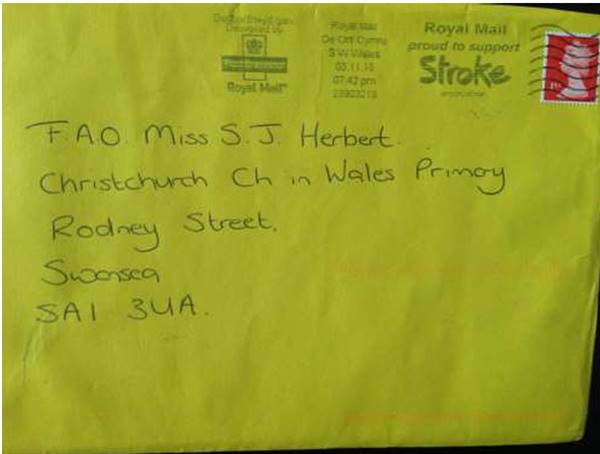


I found the intrusion into Sarah Jayne Herbert’s workplace deeply concerning and distressing. Emma Calved had not been introduced to Sarah Jayne Herbert, and the use of personal information to contact her at her place of work appeared to represent a deliberate and unwanted intrusion into her private and professional life.
The decision to send an abusive card to a primary school was particularly distressing given the setting and the involvement of school staff. It caused clear upset to those who received and saw the communication.
When I reported this matter to PC Ball (SWP 4639) at Swansea Central Police Station, I felt that the seriousness of the situation was not fully recognised. From my perspective, it was treated as a routine report rather than as part of a wider pattern of malicious communications and harassment that had already been brought to the attention of South Wales Police.
The impact of these events on Sarah Jayne Herbert was significant and distressing. I am aware that she experienced considerable emotional upset as a result of the incident.
11. March 2016 – MasterChef
In March 2016, I experienced a significant escalation in the pattern of malicious communications that I had previously reported to South Wales Police.
During that month, I appeared as a contestant on the BBC programme MasterChef. On the evening that the episode was broadcast, Emma Calved created multiple Twitter accounts and used them to publish messages about me. These messages tagged both me and my university employer and contained allegations and statements that I considered to be false, malicious, and damaging to my reputation.
Sarah Jayne Herbert and I watched the programme together at my home at 33 Kilvey Terrace. What should have been a positive and memorable occasion quickly became distressing as we witnessed a large volume of hostile and damaging messages being published online. The timing of the communications appeared designed to coincide with the national television broadcast and maximise their impact.
The following day, I became aware that Emma Calved had also contacted other MasterChef contestants and my university employer. This extended the impact of the communications beyond my personal life and into my professional and public reputation. The incident was humiliating and deeply upsetting, particularly as it affected not only me but also individuals associated with the programme and my place of work.
I reported the matter to PC Ball (SWP 4639) at Swansea Central Police Station the following day and provided printed screenshots of the social media posts and communications. During this meeting, I was informed that the matter fell within the jurisdiction of Gwent Police because Emma Calved resided in Newport.
Relevant legislation:
• Malicious Communications Act 1988
• Communications Act 2003, Section 127
• Protection from Harassment Act 1997, Sections 2A and 4A
• Serious Crime Act 2015, Section 76
The impact of this incident upon me was considerable. My appearance on MasterChef should have been a positive personal achievement and a moment that I could share with family, friends, and colleagues. Instead, it became overshadowed by a campaign of online communications that I believed were intended to embarrass, humiliate, and distress me. The fact that these communications extended to my employer and other contestants made the experience particularly difficult and left me feeling exposed, vulnerable, and unsupported despite having reported previous incidents to the police and provided evidence of a continuing pattern of behaviour.
12. May 2016 – MyDiscombobulatedBrain Charity
I reported to PC Ball (SWP 4639) at Swansea Central Police Station that Emma Calved had contacted Laura Dernie following the publication of a WalesOnline article concerning Laura’s mental health charity, MyDiscombobulatedBrain.
At the time, I had been supporting the charity through a fundraising pop-up event, contributing both my time and personal resources. Following publication of the article, Emma Calved sent communications relating to both me and the charity. I provided PC Ball with copies of the messages, which I believed were intended to cause distress and anxiety and which contained statements that I considered false and damaging.
I drew PC Ball’s attention to the fact that he had previously dealt with reports of similar communications involving Emma Calved. Despite this history, I was informed that the matter was complicated by jurisdictional issues because Emma Calved resided in Newport.
What particularly concerned me was that the communications appeared to extend beyond me personally and affected individuals and organisations with whom I was associated. I had become involved with the charity solely to support a longstanding friend and a worthwhile cause. Nevertheless, the situation resulted in unwanted communications being directed towards individuals connected with that work.
Relevant legislation:
• Malicious Communications Act 1988
• Communications Act 2003, Section 127
• Protection from Harassment Act 1997, Sections 2A and 4A
• Serious Crime Act 2015, Section 76
The incident caused me significant distress. I received a number of communications that I believed were intended to upset and intimidate me, while Laura Dernie also contacted me regarding the disruption caused by Emma Calved’s actions. I had deliberately kept my involvement in the fundraising event low-profile, and it was deeply concerning that Emma Calved became aware of it and subsequently made contact in a manner that affected both me and the charity. The incident created anxiety, worry, and a sense that activities undertaken for charitable purposes were being drawn into an ongoing pattern of unwanted and distressing behaviour.
13. June 2016 – Formal Complaint of Malicious Communication by UWTSD
In June 2016, Cheryl Buckley and I jointly reported a further incident of malicious communication by Emma Calved to PC Ball (SWP 4639) at Swansea Central Police Station.
The incident involved a telephone call made directly to Cheryl Buckley in her capacity as a representative of my university employer. This was particularly concerning because it was not an isolated occurrence. Cheryl had previously been subjected to unwanted and abusive communications from Emma Calved, including demands for information relating to my employment and salary. Those earlier incidents had already been reported to South Wales Police.
On this occasion, I was asked to attend the Human Resources Department, where Cheryl Buckley informed me of the latest communication. She was understandably upset and frustrated by the continuing nature of the contact. Given the history of previous reports and the effect these communications were having on my workplace, we attended Swansea Central Police Station together to make a formal complaint.
The matter was reported to PC Ball (SWP 4639), who had previously dealt with similar complaints involving Emma Calved and had cautioned her in September 2015 regarding malicious communications. By June 2016, there had been numerous reports of unwanted and distressing communications involving both myself and individuals connected with my personal and professional life.
Relevant legislation:
• Malicious Communications Act 1988
• Protection from Harassment Act 1997, Sections 2A and 4A
• Serious Crime Act 2015, Section 76
At this stage, I had been in my role as Professor for approximately one year. The continued contact with my employer and Human Resources Department was both embarrassing and distressing. What should have been a period focused on establishing my academic career was repeatedly disrupted by incidents that drew colleagues and university staff into matters entirely unrelated to their professional responsibilities.
The cumulative effect of these communications had a significant impact on my wellbeing. Repeated reports had been made to South Wales Police, yet the unwanted contact continued. The fact that Cheryl Buckley accompanied me to make a formal complaint demonstrated that the issue was no longer affecting me alone but was also impacting members of staff within my workplace.
14. 1st August 2016 – Family Court Order
On 1 August 2016, I applied to the Family Court for a formal child arrangements order concerning contact with my daughters, Charlotte and Marissa.
During the proceedings, I provided safeguarding evidence to CAFCASS, including digital recordings which, in my view, raised concerns regarding the welfare and supervision of the children. The recordings related to occasions when the children, then aged 8 and 11, were allegedly left unsupervised in Newport, Gwent.
The Family Court subsequently made an order governing contact arrangements. However, in my view, the terms of that order were not complied with for any significant period of time. I contend that the arrangements established by the court broke down within approximately two weeks of the order being made. Evidence relating to these events was preserved and subsequently published on my YouTube channel.
I provided a copy of the Family Court order to PC Rhys Williams (SWP 5963) during my meeting with him at Morriston Police Station on 16 May 2018. The order is contained within the documentation supplied to South Wales Police and referenced at page(s) [x] of Appendix B. Accordingly, PC Williams was made aware of the existence of the court order, the contact arrangements it established, and my concerns regarding compliance with those arrangements.
Relevant references:
• Newport Family Court – Case No. NP16P00374
• Evidence subsequently provided to South Wales Police
• YouTube channel records documenting relevant events
I sought the assistance of the Family Court because I wished to maintain a lawful and structured relationship with my daughters. Obtaining a court order required considerable time, effort, and emotional investment. The subsequent breakdown of the arrangements shortly after the order was made was deeply upsetting and had a significant impact on my wellbeing. It left me feeling that, despite pursuing the proper legal channels, the stability and certainty that the court process was intended to provide had not been achieved.
15. November 2017 – Contact University Employer
In November 2017, I experienced what I consider to have been one of the most distressing periods of my life. During this time, there was a further escalation in the pattern of unwanted communications and contact that I had repeatedly reported to South Wales Police. These communications extended beyond me personally and involved my employer, friends, acquaintances, PhD students, and members of my family.
The events occurred during a significant period in my personal life, coinciding with Sophie Carter-Ingram’s pregnancy. The cumulative effect of the ongoing communications and the involvement of people connected to me placed considerable strain on both my professional and personal circumstances.
At around the same time, contact with my daughters, Charlotte and Marissa, ceased despite the existence of a Family Court order governing contact arrangements. I was also informed that my parents had been presented with a choice between maintaining contact with me or continuing to see their grandchildren. This development caused significant distress not only to me but also to members of my wider family.
These matters were reported to an officer at Swansea Central Police Station as part of my continuing efforts to seek assistance and protection. By this stage, I had made numerous reports concerning unwanted communications and related conduct over a prolonged period.
Relevant legislation:
• Malicious Communications Act 1988
• Protection from Harassment Act 1997, Sections 2A and 4A
• Serious Crime Act 2015, Section 76
The impact of these events upon me was profound. I had worked exceptionally hard to establish my academic career and achieve my position as a Professor. The continuing pattern of communications and the involvement of my employer and professional contacts caused significant embarrassment, anxiety, and emotional exhaustion.
The simultaneous loss of contact with my daughters was particularly devastating. Despite pursuing legal remedies and repeatedly reporting matters to the police, I felt unable to prevent the ongoing disruption to my personal and professional life. The combined effect of these events had a substantial impact on my mental wellbeing, family relationships, and career, the consequences of which I continue to feel today.
16. 25th November 2017 - Harassment and Stalking
On 25 November 2017, Sophie Carter-Ingram and I reported seven separate incidents of alleged malicious communications and stalking to PC O’Neale (SWP 5498) and PC Thomas (SWP 5688), who attended my home to discuss the matter.
During this meeting, we provided evidence which, in our view, demonstrated a continuing pattern of behaviour extending over several years. We explained that similar incidents had previously been reported to South Wales Police and involved not only ourselves but also family members, friends, colleagues, and other individuals connected to us. The evidence provided included communications and information which we believed demonstrated a sustained course of conduct directed towards causing distress and anxiety.
Particular concern was raised regarding evidence indicating that Emma Calved had been present outside Sophie Carter-Ingram’s home in Swansea. We explained to the officers that this had caused considerable alarm and distress, particularly given that Sophie was pregnant at the time.
Relevant legislation:
• Malicious Communications Act 1988
• Protection from Harassment Act 1997, Sections 2A and 4A
• Serious Crime Act 2015, Section 76
The meeting was deeply significant to us because it provided an opportunity to present the history of events directly to attending officers. Sitting in my kitchen with two police officers, we detailed the incidents that had occurred, provided supporting evidence, and explained the impact that the conduct was having on our daily lives.
I explained to the officers that I no longer felt safe in my own home. Sophie Carter-Ingram similarly stated that she did not feel safe at her property in Morriston, particularly given the evidence suggesting that photographs had been taken of her home and that her address had become a focus of unwanted attention.
The effect on Sophie was especially concerning because she was pregnant at the time. The ongoing anxiety and fear associated with these events significantly affected our sense of security. Ultimately, Sophie relocated to Llandeilo, Carmarthenshire, in part because she no longer felt comfortable or safe remaining at her Morriston address.
In our view, the evidence presented on 25 November 2017 demonstrated not isolated incidents but a continuing pattern of behaviour that had been repeatedly reported to the police over a number of years. The cumulative impact of these events on our wellbeing, family life, and sense of personal safety was substantial.
17. Harassment and Stalking
Throughout this period, I became increasingly concerned that Emma Calved was obtaining information about my daily activities, visitors, and movements despite residing in Newport, Gwent, some distance from my home at 33 Kilvey Terrace, Swansea.
I believed that information regarding individuals visiting my property and my day-to-day movements was being relayed to Emma Calved by persons known to me, including Gillian Morton, Kelly Morton, Lorraine Powell, Sarah Powell, and Laura Powell. This belief was based on numerous occasions where Emma Calved appeared to possess knowledge of events occurring at or around my property that I could not readily explain.
On multiple occasions, I received communications from Emma Calved shortly after individuals had visited my home. In some instances, messages were sent asking who had attended the property or making reference to events that had occurred there. The timing and content of these communications led me to believe that information about my private life and movements was being monitored and passed to her by third parties.
I reported these concerns to South Wales Police and provided examples which, in my view, demonstrated a pattern of behaviour consistent with stalking and ongoing monitoring. Evidence relating to these concerns was presented to officers during meetings on 25 November 2017 and again on 16 May 2018. I explained that these incidents should not be viewed in isolation but as part of a wider pattern of conduct that had developed over several years and involved repeated unwanted communications, intrusion into my personal life, and contact with individuals connected to me.
Relevant legislation:
• Malicious Communications Act 1988
• Protection from Harassment Act 1997, Sections 2A and 4A
• Serious Crime Act 2015, Section 76
The psychological impact of these events was considerable. Over time, I developed a persistent feeling that my movements and activities were being monitored and reported to another person without my knowledge or consent. What should have been the privacy and security of my own home increasingly felt compromised.
The effect was that I no longer felt comfortable in my own property. Visitors to my home, routine social interactions, and even ordinary daily activities became a source of anxiety because I feared that details would quickly be communicated to Emma Calved and followed by further unwanted messages or contact. The cumulative effect of years of perceived monitoring, harassment, and unwanted communications had a significant impact on my sense of security, privacy, and wellbeing.
18. March 2018 – Malicious Message to Sophie Carter-Ingram when Pregnant
In March 2018, Emma Calved sent a message to Sophie Carter-Ingram via Facebook. The content of the message was, in our view, malicious, targeted, and intended to cause distress. The communication was particularly upsetting given that Sophie Carter-Ingram was pregnant at the time.
The message was reported to South Wales Police and preserved as evidence. We considered the communication to be part of a wider pattern of unwanted contact and behaviour that had previously been reported to the police on numerous occasions. The timing and content of the message caused significant concern because it appeared to target Sophie Carter-Ingram during a particularly vulnerable period of her life.
The impact of the communication was immediate and substantial. Sophie Carter-Ingram became extremely distressed upon receiving the message, and the incident caused considerable anxiety for both of us. Rather than being an isolated event, it formed part of a continuing course of conduct that had increasingly affected our personal lives, sense of security, and emotional wellbeing.
The message was subsequently provided to PC Rhys Williams (SWP 5963) during our meeting on 16 May 2018. According to PC Williams’ oral testimony in court, he later shared this material with PC Laura Murphy (GWP 1794). Accordingly, both officers were made aware of the communication and its contents.
Relevant legislation:
• Malicious Communications Act 1988
• Protection from Harassment Act 1997, Sections 2A and 4A
• Serious Crime Act 2015, Section 76
The emotional effect of this incident was profound. I felt helpless watching Sophie Carter-Ingram become so distressed by a communication that appeared designed to upset and intimidate her. As an expectant mother, she should have been able to enjoy her pregnancy without fear of unwanted intrusion or hostile communications.
The distress caused by the message was not momentary. Sophie remained visibly upset for a considerable period afterwards, and the incident affected our sense of security and wellbeing. The fact that the communication appeared to target her during pregnancy made the experience particularly upsetting and contributed to our growing concern that the pattern of conduct we had repeatedly reported was continuing unchecked.
More broadly, this incident reinforced our belief that the conduct was no longer directed solely at me but had expanded to include those closest to me. The resulting emotional strain affected both our personal lives and our ability to enjoy what should have been a positive and important period for our family.
19. 12th May 2018 – False Impersonation of Children
While travelling home from a conference at the Royal College of Physicians concerning the prevention of deaths in police custody, Sophie Carter-Ingram and I received a series of messages purporting to be from my daughters, Charlotte and Marissa.
The content and nature of the messages caused us immediate concern. Based on the language used and the circumstances at the time, we became worried that the messages may not have been sent by the children themselves and that there could be an issue affecting their welfare. Given the ages of the children, then 10 and 14, we considered the situation sufficiently serious to contact Gwent Police and request an immediate welfare check.
Acting as concerned parents, we provided the attending officers with the messages that had been received and explained the reasons for our concerns. We also supplied a copy of the Family Court order that was in force at the time and provided any information requested to assist officers in assessing the situation.
Two female Gwent Police officers attended the address in Newport. Following their attendance, we were informed that both girls had been located at the property and were found in their bedrooms without access to their mobile phones. This information did not alleviate our concerns regarding the origin of the messages and whether they had genuinely been sent by the children.
The incident and the messages received were subsequently reported to PC Rhys Williams (SWP 5963) during a meeting at Morriston Police Station on 16 May 2018. Copies of the messages were provided as evidence. According to PC Williams’ subsequent courtroom testimony, this material was later forwarded to PC Laura Murphy (GWP 1794) for consideration and investigation.
Relevant legislation:
• Children Act 1989
• Serious Crime Act 2015, Section 76
The incident caused significant anxiety and distress. What had already been a disappointing day, during which I had been unable to spend time with Charlotte and Marissa, quickly developed into genuine concern for their welfare and safety. The nature of the messages led Sophie Carter-Ingram and me to fear that something was wrong, prompting us to seek police assistance without delay.
When the attending officers reported that the girls had been located, I was relieved to know that they were physically safe. However, concerns remained regarding the circumstances surrounding the communications and whether the messages had originated from the children themselves.
I considered that I had acted responsibly by seeking a welfare check and by subsequently reporting the matter to South Wales Police with supporting evidence. Given the concerns raised and the information provided, I was disappointed that the matter did not appear to receive the level of attention or urgency that I believed was warranted. The experience left me feeling frustrated and concerned that issues affecting the welfare of my children were not being fully explored despite being formally reported to the police.
20. 16th May 2018 – Reporting Offences to PC Rhys Williams (SWP 5963)
On 16 May 2018, I attended Morriston Police Station and met with PC Rhys Williams (SWP 5963). During that meeting, I provided a substantial body of evidence relating to numerous incidents that I had reported over a period of several years. Among the matters raised were allegations of assault, theft, blackmail, malicious communications, harassment, safeguarding concerns involving my children, and messages that I believed involved the false impersonation of my daughters on 12 May 2018.
I attended the meeting in good faith and placed my trust in PC Williams, as a serving police officer and agent of the state, to objectively review the evidence provided, assess any safeguarding concerns, and ensure that the matters reported were properly investigated.
The material provided to PC Williams included:
- A 200-page dossier relating to Emma Calved and the history of events reported to police.
• More than 1,000 pages of digital evidence.
• Twenty-four separate folders documenting individual incidents of alleged malicious communications directed towards me and others connected to me.
• Screenshots and records relating to the messages received on 12 May 2018, which I believed involved the false impersonation of my daughters.
• Evidence relating to the assault reported in July 2014.
• Evidence relating to the theft of property reported on 26–27 July 2014.
• Evidence relating to ongoing threatening, abusive, and unwanted communications reported over several years.
• Evidence which, in my view, raised safeguarding concerns regarding the welfare of my children.
The significance of this material was explained during the meeting. I made clear that the evidence did not relate to a single isolated incident but demonstrated what I believed to be a continuing pattern of conduct spanning several years, involving multiple victims, repeated reports to police, and a substantial volume of documentary evidence.
Relevant legislation cited within the material included:
- Offences Against the Person Act 1861, Sections 20 and 47
• Theft Act 1968, Sections 1 and 9
• Theft Act 1968, Section 21 (Blackmail)
• Criminal Justice Act 2003, Section 329
• Malicious Communications Act 1988
• Protection from Harassment Act 1997, Sections 2A and 4A
• Serious Crime Act 2015, Section 76
My concern is not merely that evidence was provided, but that despite the volume and seriousness of the material submitted, I saw no meaningful progress in relation to a number of the matters reported. In particular, I had provided evidence that I believed raised safeguarding concerns regarding two children, evidence relating to the alleged impersonation of minors, and information indicating that property reported stolen in July 2014 remained in Emma Calved’s possession years later.
From my perspective, the evidence warranted careful investigation, inter-force coordination where necessary, and consideration of safeguarding measures. Instead, I was left with the impression that the significance of the material was not reflected in the response that followed.
The lasting impact of this has been profound. By May 2018, I had spent years reporting incidents, preserving evidence, attending police stations, providing witness material, and cooperating with officers. I believed I had done everything reasonably expected of a victim and complainant. Having provided such extensive documentation and evidence, I felt deeply disappointed and let down by what I perceived to be an inadequate response to matters that I considered serious, ongoing, and well-evidenced.
Particularly troubling was the fact that the material included concerns relating to the welfare of my daughters and information suggesting that property reported stolen almost four years earlier had still not been recovered. I attended Morriston Police Station believing that the evidence would finally result in meaningful action. When that did not occur, it significantly undermined my confidence in the ability of the police to investigate the matters I had repeatedly reported.
21. 19th April 2019 – Arrest by PC Rhys Williams
On 19 April 2019, I was arrested by PC Rhys Williams (SWP 5963) in relation to an allegation of so-called “revenge pornography.”
The allegation was based upon a claim that Benjamin Jones, the husband of Emma Calved’s sister, had allegedly viewed a pornographic video whilst living in Glasgow and had identified both Emma Calved and me from the contents of the video. I have consistently maintained that this allegation was implausible, unreliable, and incapable of withstanding proper scrutiny.
In my view, the circumstances surrounding the allegation raised a number of obvious evidential concerns. Benjamin Jones had never met me and, to the best of my knowledge, had no personal knowledge of me prior to the matters disclosed during the subsequent criminal proceedings. Despite this, it was alleged that he was able to identify me from material viewed remotely and under circumstances that appeared inherently questionable.
The timing of the complaint also caused concern. The allegation was reported on the same day that Sophie Carter-Ingram and I had requested a welfare check through Gwent Police concerning Charlotte and Marissa. Given the history of disputes, previous reports to police, and ongoing family court proceedings, I believed that the circumstances surrounding the allegation warranted particularly careful examination.
What was especially troubling to me was that PC Rhys Williams had already been provided with extensive background information during our meeting at Morriston Police Station on 16 May 2018. At that meeting, I had supplied substantial documentary evidence relating to previous allegations, malicious communications, safeguarding concerns, theft, blackmail, and the continuing possession of property reported stolen in July 2014.
I had also provided evidence which, in my view, raised serious concerns regarding the credibility and reliability of a number of allegations that had previously been made against me. Furthermore, police records and the information already supplied to South Wales Police should have demonstrated the lengthy and complex history between the parties involved.
Against that background, I believe that the allegation required rigorous evidential assessment and corroboration. My concern is that insufficient weight was given to the wider context known to investigators and to the substantial body of evidence already held by the police.
Relevant legislation:
• Protection of Children Act 1978 (where applicable to digital imagery investigations)
• Criminal Justice and Courts Act 2015 (Revenge Pornography provisions)
• Perverting the Course of Justice (common law offence)
The arrest itself had a profound impact on me. By April 2019, I had spent several years reporting matters to the police, providing extensive documentary evidence, attending police stations, and seeking assistance regarding what I believed to be ongoing criminal conduct directed towards me and those close to me. Instead of seeing progress in relation to those reports, I found myself being arrested in relation to allegations that I considered wholly unfounded.
The psychological impact was considerable. I felt that years of evidence I had provided had been overlooked, while allegations made against me appeared to be acted upon with far greater urgency. This significantly damaged my confidence in the fairness and objectivity of the investigation process.
I was also concerned about the wider consequences of the arrest. The ongoing failure to recover property reported stolen in July 2014, including computer equipment and data belonging to third parties, had already caused substantial disruption to my professional activities, business relationships, and academic responsibilities. By 2019, these unresolved matters had affected not only me personally but also organisations, colleagues, and students who had relied upon my work.
For these reasons, I believe the circumstances leading to my arrest warrant careful examination, including whether the available evidence, the known history between the parties, and the information already held by South Wales Police were given appropriate consideration before significant investigative decisions were taken.
22. 19th April 2019 – Interview
During my interview with PC Robert Crabtree (SWP 5749), I provided details of the assault that I had reported in July 2014 and explained that, within days of that incident, Emma Calved had allegedly entered my property and removed a substantial quantity of equipment, documents, and electronic storage devices.
I explained that these matters had been reported to South Wales Police at the time, including to PC Whomes (SWP 5437), and that the property had never been recovered despite the passage of several years. I further explained that the items removed were not limited to my personal possessions but included equipment, research data, and commercially sensitive information belonging to third parties.
During the course of the investigation, PC Robert Crabtree became aware that among the items allegedly removed were proprietary information and materials belonging to Detention Metrics Ltd, together with research data and thesis materials relating to Rebecca Whittall’s PhD. My understanding is that this information was subsequently communicated to PC Rhys Williams (SWP 5963) and recorded within police records, including at page 662 of the relevant disclosure material.
The significance of this information extended beyond the loss of personal property. The alleged theft involved research materials, commercial information, academic work, and electronic devices that were important to ongoing professional activities. The continued absence of these items had implications not only for me personally but also for organisations and individuals whose work depended upon the data and materials that had been removed.
My concern is that, despite officers being informed of these matters and despite the information being recorded within police systems, I saw no meaningful progress towards recovering the property, identifying where it was being held, or addressing the wider implications of the alleged theft. By the time of my interview with PC Crabtree, the allegations had been known to the police for several years.
In my view, the information provided should have prompted a thorough review of the original reports, consideration of the evidential material already held, and an assessment of what investigative opportunities remained available. Instead, I was left with the impression that significant allegations involving assault, theft, blackmail, and the retention of property belonging to multiple parties had not been pursued with the diligence that the circumstances warranted.
The impact of this was considerable. The loss of the equipment and data affected my professional activities, academic work, and business interests for many years. It also affected third parties whose information and research materials were involved. The continued lack of resolution compounded the distress caused by the original incidents and reinforced my belief that the matters I had repeatedly reported were not receiving the level of investigative attention they deserved.
From my perspective, the issue was not simply that historic allegations existed, but that officers continued to receive information confirming the significance of those allegations and the ongoing consequences arising from them. Despite this, the position remained unchanged, and the property was never recovered. This contributed significantly to my loss of confidence in the police response and had a lasting psychological impact on me and others affected by the disappearance of the equipment and data.
23. Devices Seized on the 12th April 2019
Following the seizure of electronic devices and storage media, I made twelve formal requests to PC Rhys Williams (SWP 5963) and Martin Richards (SWP 57076) seeking the return of property that did not belong to me and which, in my view, should not have remained in police possession. Copies of these requests are contained within the disclosure material at pages [x].
The property included devices and digital storage media containing information belonging to third parties, including academic and commercial material unrelated to the allegations being investigated. Despite repeated requests over an extended period, these items were not returned.
Of particular concern was the retention of a hard drive containing material belonging to a PhD student. The continued unavailability of this data had serious academic consequences. The student was deprived of access to research materials necessary for the continuation of their studies and, as a result, was ultimately unable to continue their PhD programme. The emotional and professional impact upon that individual was significant and entirely foreseeable once it became clear that the material would not be returned within a reasonable period.
A further example concerns a 32GB pen drive containing information relating to Detention Metrics Ltd. Police records indicate that PC Robert Crabtree (SWP 5749) requested the return of this device on the same day it was seized, as recorded within the police logs at page 662. Despite that request, the device was not returned. The retention of material which an investigating officer had already identified as suitable for return raises serious questions regarding the necessity and proportionality of its continued seizure.
My concern is that the continued retention of these items was inconsistent with the principles governing the seizure and retention of property under the Police and Criminal Evidence Act 1984 (PACE). Once property is no longer required for evidential purposes, there is an obligation to consider its return to its lawful owner. In this case, repeated requests were made, ownership was identified, and the consequences of continued retention were explained, yet the position remained unchanged.
The impact of these decisions extended far beyond inconvenience. The retained devices contained research data, academic work, commercial information, and materials belonging to third parties who had no involvement in the allegations under investigation. Their continued retention disrupted professional activities, delayed research projects, affected business operations, and caused substantial distress to those deprived of access to their own property.
The cumulative psychological and financial consequences have been considerable. Years after the original seizure, individuals remained without access to their property despite repeated requests for its return. The resulting uncertainty, disruption, and damage to academic and professional work have had lasting effects on those concerned.
My complaint is not simply that property was seized, but that after ownership had been established, requests for return had been made, and the adverse consequences had been brought to the attention of South Wales Police, the continued retention of these items appeared neither necessary nor proportionate. In my view, these circumstances warrant careful examination to determine whether the requirements and safeguards contained within PACE were properly applied and whether reasonable steps were taken to minimise the harm caused to innocent third parties.
24. Detention Metrics Ltd
Caerwyn Ash spent the first quarter of 2017, as a professor working on a report for the Home Office to prevent deaths in police custody. Caerwyn Ash created a business called Detention Metrics Ltd in 2018.
In October 2018, a working prototype of Detention Metric Ltd was tested at the police federation conference in Coventry. The Daily Mail article on this project [page 1039-1043]. In March 2019, £2.4 million of funding was in place to launch this device into service in Custody suites in the UK.
On the 19th April 2019, PC Rhys Williams seized the devices owned by Detention Metrics Ltd, Boxican Ltd, Asthma Dual ltd, Powered Sleep ltd and SmartHoney ltd and have refused to return them to hide the fact that 11 months previously he was the reporting officer on a plethora of evidence on the same person making a false allegation and failed in his duty to investigate.
Weblink to dailymail
25. Meeting PR Rhys Williams and PC Jack Williams
hghvhgvjh
26. 2019 - BBC Interview
In 2019, Emma Calved participated in an interview with the BBC’s Victoria Derbyshire programme. At the time of that broadcast, I remained concerned that matters I had reported to both South Wales Police and Gwent Police over a number of years had not been properly investigated or resolved.
Among those matters were my allegations that, following the assault reported on 25 July 2014, Emma Calved unlawfully removed computer equipment, storage devices, and other property from my home on 26–27 July 2014. I had reported the alleged theft to PC Whomes (SWP 5437) at the time and provided evidence which, in my view, demonstrated both ownership of the property and subsequent communications relating to the items.
I had also provided copies of messages which I believed contained threats to damage or destroy the equipment if I continued to pursue complaints relating to the assault. These matters were repeatedly brought to the attention of police officers over a period of several years and formed part of the extensive documentary evidence later supplied to South Wales Police.
My concern is that, despite the seriousness of the allegations and the repeated reports made to the police, there appeared to be no meaningful attempt to recover the property, establish its whereabouts, or resolve the issues that had remained outstanding since 2014. As a result, by the time of the 2019 broadcast, I believed that important evidence and property remained unaccounted for despite having been reported to the police on numerous occasions.
The significance of this issue extends beyond the original loss of property. The devices reportedly contained personal information, academic research, commercial material, and data belonging to third parties. Their continued absence had already caused substantial disruption to professional activities, business projects, and academic work. The fact that these matters remained unresolved years later contributed to my belief that earlier reports had not received the level of investigation they warranted.
My concerns were compounded by the fact that, in April 2019, South Wales Police had seized electronic devices and storage media from me under powers contained within the Police and Criminal Evidence Act 1984 (PACE). Following those seizures, repeated requests were made for the return of property and data belonging to myself and third parties. Despite those requests, a number of items remained unavailable for an extended period.
In my view, there is a stark contrast between the extensive investigative powers exercised against me and the apparent lack of progress in relation to allegations and evidence that I had been reporting since 2014. This disparity significantly undermined my confidence in the fairness and proportionality of the investigative process.
The psychological impact of these events has been profound. By 2019, I had spent years reporting allegations, preserving evidence, attending police stations, complying with police requests, and seeking assistance through the proper channels. Despite these efforts, I remained without the return of property that I had reported stolen, while simultaneously experiencing the seizure and retention of my own business and research materials.
The cumulative effect was a growing sense of frustration, helplessness, and loss of confidence in the criminal justice process. The unresolved allegations, the continuing absence of property, and the prolonged retention of devices under PACE created significant anxiety and uncertainty, affecting both my personal wellbeing and professional life.
I was also concerned about the impact of public allegations upon my reputation. The publication and repetition of allegations that I strongly dispute had consequences extending beyond the criminal investigation itself. Professionally, I felt that my reputation had been damaged, and I remain concerned that these events have adversely affected future employment opportunities, business relationships, and public perception.
My complaint is not simply that allegations were made or reported publicly. Rather, it is that significant matters reported by me over many years remained unresolved despite extensive evidence being provided, while substantial investigative powers were exercised against me. In my view, these circumstances warrant careful examination to determine whether police powers were exercised fairly, proportionately, and in accordance with the safeguards and principles contained within the Police and Criminal Evidence Act 1984.
27. 31st October 2021 - Disclosing Confidential Information
I have serious concerns regarding the handling and disclosure of personal and confidential information by Martin Richards (SWP 57076) and Lyndsay Howe (SWP 5534) during the course of the investigation.
My concern is that information relating to allegations made against me was disclosed more widely than was necessary for the purposes of the investigation and in circumstances that caused significant personal, professional, and commercial harm. In particular, I believe that information relating to allegations of revenge pornography and illegal images was communicated to individuals connected to my businesses and professional activities before those allegations had been properly tested or determined.
The consequences of these disclosures were substantial. The allegations had the potential to cause immediate reputational damage, undermine business relationships, affect commercial confidence, and damage the standing of companies with which I was associated. Once such allegations become known within professional circles, the resulting harm can be immediate and difficult to reverse, regardless of the eventual outcome of any investigation.
On the evening of 31 October 2021, I attended Swansea Central Police Station and met with Martin Richards (SWP 57076) and Lyndsay Howe (SWP 5534). During that meeting, I explained that I required sufficient time to obtain appropriate legal representation and that arrangements needed to be made with legal advisers based in London. Despite these concerns, I was informed that an interview would be required the following day.
I was provided with the details of a local solicitor, India Beavan of Evans, Hayes and Burnell, and informed that legal representation had been arranged for the interview. Given the seriousness of the allegations and the complexity of the matters involved, I felt considerable pressure to proceed within a significantly compressed timescale.
My concern is that insufficient consideration was given to ensuring that I had a reasonable opportunity to obtain legal advice and prepare for interview. The safeguards contained within the Police and Criminal Evidence Act 1984 (PACE) are intended to ensure fairness, transparency, and the protection of the rights of those under investigation. In circumstances involving serious allegations with potentially life-changing consequences, those safeguards are particularly important.
The events surrounding the investigation had a profound impact upon me personally and professionally. The disclosure of allegations to individuals connected to my businesses and professional activities caused embarrassment, anxiety, and significant reputational damage. Relationships that had taken years to build were placed under strain, and confidence in my professional integrity was undermined.
The psychological consequences were severe. I experienced considerable stress arising not only from the allegations themselves but also from the manner in which information relating to those allegations was communicated and handled. The uncertainty surrounding the investigation, the impact upon my businesses, and the damage to my professional reputation combined to create an overwhelming sense of anxiety and vulnerability.
The financial consequences were also significant. Commercial opportunities were affected, business relationships were disrupted, and the reputational damage associated with the allegations created uncertainty for companies, staff, and professional associates connected with me.
My complaint is not limited to the fact that an investigation took place. Rather, it concerns whether personal information was disclosed only where necessary and proportionate, whether appropriate regard was given to confidentiality and reputational harm, and whether the safeguards contained within PACE and related legislation were properly observed throughout the investigative process.
Relevant legislation:
- Police and Criminal Evidence Act 1984 (PACE)
• Data Protection Act 2018, Section 132
• UK General Data Protection Regulation (UK GDPR)
28. 1st November 2021 – Voluntary Interview
On 1 November 2021, I met with my solicitor, India Bevan, and provided her with a prepared statement prior to my police interview. The statement was subsequently emailed at approximately 10:00 a.m. and contained detailed information relevant to the allegations under investigation.
Importantly, the statement identified fourteen individuals who had access to the computers and electronic devices that formed part of the investigation, including Trevor James and other persons with legitimate access to the equipment. In my view, this information was highly relevant because it demonstrated that multiple individuals, rather than myself alone, had access to the devices and systems that were the subject of the allegations.
The statement was intended to assist the investigation by identifying potential lines of enquiry and individuals who could be spoken to by police. It also provided information which, in my view, was capable of assisting investigators in establishing a more complete and balanced understanding of the circumstances surrounding the allegations.
During the interview, I also informed officers of a tragic and significant development. Only hours earlier, my business partner had died by suicide following police contact at his restaurant. I explained that I was attempting to participate in a serious criminal investigation whilst simultaneously dealing with an unexpected and devastating personal tragedy.
Despite the exceptional circumstances, the interview proceeded. The emotional impact of learning of my business partner’s death on the same day as being interviewed under caution cannot be overstated. I was required to answer complex allegations while experiencing acute grief, shock, and distress.
On 2 November 2021, I instructed India Bevan to provide my prepared statement to the police to ensure that the information contained within it formed part of the investigative record. My understanding was that the statement contained material capable of assisting the investigation, identifying alternative lines of enquiry, and providing important context to the allegations being examined.
Subsequently, uncertainty arose regarding whether the statement had in fact been provided to the police. This issue became increasingly significant because the contents of the statement related directly to matters that I believed should have been considered during the investigation.
A witness summons was later sought in respect of India Bevan. However, she did not attend court and did not provide a witness statement addressing the issues surrounding the prepared statement and its handling. Despite the significance of this evidence, no further clarification was obtained regarding whether the statement had been received, considered, or acted upon by investigators.
My concern is that the circumstances raise important questions regarding the completeness of the investigation and whether all relevant material was properly obtained, reviewed, and considered. Where information is provided identifying multiple individuals with access to relevant devices and setting out potential lines of enquiry, I believe that information should be carefully examined as part of any fair and balanced investigation.
The safeguards contained within the Police and Criminal Evidence Act 1984 (PACE) exist to ensure that investigations are conducted thoroughly, fairly, and objectively. In my view, those safeguards require investigators to pursue reasonable lines of enquiry, whether they point towards or away from a suspect. My concern is that information capable of identifying alternative explanations and additional witnesses was not afforded the level of consideration that it warranted.
The psychological impact of these events was substantial. I was attempting to engage fully with the investigation while dealing with the sudden death of a business partner, the collapse of important business relationships, and allegations that had already caused significant reputational damage. The uncertainty surrounding whether relevant evidence had been provided, received, or considered added further anxiety and undermined my confidence that the investigation was being conducted in a fair and balanced manner.
The cumulative effect was a profound sense of frustration, helplessness, and emotional exhaustion. At a time when I was already coping with bereavement, financial uncertainty, and the consequences of a lengthy investigation, I was left with concerns that potentially important evidence and investigative opportunities had not been fully explored.
29. March 2022 – Aldi
In March 2022, whilst shopping at Aldi, Parc Tawe, Swansea, I unexpectedly encountered Martin Richards (SWP 57076) and Kelly Hurley (SWP 5678). Given the length of time that had elapsed since my interview and the substantial volume of evidence that had been provided to South Wales Police, I took the opportunity to enquire about the progress of the investigation.
During our brief conversation, I asked Martin Richards whether any enquiries had been undertaken in relation to Trevor James or Emma Calved following the information contained within the prepared statement that had been provided through my solicitor, India Bevan. As previously explained to investigators, that statement identified multiple individuals with access to the computers and electronic devices that formed part of the investigation and, in my view, raised reasonable lines of enquiry that should have been considered.
Martin Richards informed me that the case papers had been submitted to the Crown Prosecution Service (CPS). When I sought clarification regarding whether Trevor James or Emma Calved had been investigated, interviewed, or otherwise considered as part of those enquiries, he replied that he could not discuss the case further. The conversation then ended, and we continued our shopping separately.
Whilst I appreciate that officers may be restricted in what they can disclose regarding an ongoing investigation, the encounter reinforced concerns that I had held for some time regarding whether reasonable lines of enquiry had been pursued. By that stage, investigators had been provided with extensive documentary evidence, witness information, and material identifying other individuals who potentially had access to relevant devices and information.
My concern is that the Police and Criminal Evidence Act 1984 (PACE) and the wider duties imposed upon investigators require not only the gathering of evidence supporting an allegation but also the fair and objective consideration of evidence that may undermine it or point towards alternative explanations. The information provided through my solicitor was intended to assist investigators in identifying such enquiries and ensuring that the investigation remained balanced and comprehensive.
From my perspective, there was little indication that these investigative opportunities had been fully explored. The absence of any meaningful update regarding the individuals identified in my statement left me with continuing concerns about whether all relevant evidence had been considered before the matter was referred to the CPS.
The psychological impact of this uncertainty was considerable. By March 2022, I had spent years providing evidence, attending interviews, responding to requests for information, and attempting to assist the investigation. Throughout that period, I remained concerned that material capable of assisting my position had not been afforded the same attention as material relied upon to support allegations against me.
The ongoing uncertainty created significant anxiety and frustration. I felt increasingly powerless to ensure that information favourable to my position was properly considered and increasingly concerned that important lines of enquiry may have been overlooked. This perception undermined my confidence in the fairness and objectivity of the investigative process and contributed to the psychological strain that I had already experienced over several years.
My complaint is not that Martin Richards declined to discuss the details of an ongoing investigation during an informal encounter. Rather, it is that the conversation highlighted a wider concern: despite extensive evidence having been provided identifying additional witnesses, alternative explanations, and other investigative opportunities, I remained uncertain whether those matters had been properly examined in accordance with the principles of fairness, balance, and thoroughness that underpin investigations conducted under PACE.
30. September 2022 – Police informed Emma Calved of Court Date but not the defendant Caerwyn Ash
I first became aware of the forthcoming court proceedings not through official notification from South Wales Police or the Crown Prosecution Service, but after being contacted by several former friends and acquaintances, some of whom I had not spoken to for many years.
Prior to receiving any formal communication, I became aware that information relating to the case was being discussed by individuals who would not ordinarily have had knowledge of the proceedings. At the same time, Emma Calved was actively communicating with numerous individuals through direct messages and social media platforms. These communications appeared designed to influence opinions regarding the allegations and the forthcoming court proceedings.
The circumstances in which third parties appeared to have knowledge of the case before I had been formally informed caused me significant concern. It left me questioning how information regarding the proceedings had entered the public domain and whether appropriate safeguards had been applied to confidential information relating to an ongoing criminal matter.
Two days later, I received an email from Martin Richards (SWP 57076) concerning the proceedings. Before I had an opportunity to read the email in full, I encountered Martin Richards in person. We subsequently walked together to Swansea Central Police Station so that I could obtain relevant paperwork relating to the case.
During that conversation, I sought clarification regarding the material that had been provided through my solicitor, India Bevan, following my interview in November 2021. As I had consistently maintained, India Bevan had been provided with a prepared statement both electronically and in hard-copy form. That statement contained information which I considered highly relevant to the investigation, including the identification of multiple individuals with access to the devices that formed part of the allegations and information that, in my view, constituted important lines of enquiry.
The discussion left me concerned that one of two possibilities existed: either the prepared statement and supporting material had not been transmitted to South Wales Police, or the material had been received but was not included within the information ultimately considered during the investigation and referral process.
This issue was of particular significance because the statement was not peripheral evidence. It contained information that I believed was capable of assisting the investigation, identifying additional witnesses, and providing context that could potentially undermine aspects of the allegations made against me. If such material had not been considered, I was concerned that the investigation may not have benefited from a complete evidential picture.
The Police and Criminal Evidence Act 1984 (PACE) requires investigations to be conducted fairly and objectively, with reasonable lines of enquiry pursued whether they point towards or away from a suspect. My concern is that if material identifying alternative lines of enquiry, additional witnesses, and relevant contextual information was not obtained, reviewed, or disclosed, then the safeguards intended to ensure a balanced investigation may not have been fully realised.
The psychological impact of this discovery was substantial. By this stage, I had spent years responding to allegations, providing evidence, cooperating with investigators, and attempting to ensure that relevant information was available to the police. Learning that material which I regarded as critical may not have been considered created significant anxiety and undermined my confidence in the integrity of the investigative process.
I felt increasingly powerless, believing that important evidence which could assist my position had either been overlooked or not properly incorporated into the investigation. The prospect that key information may have been absent from the material considered by investigators and prosecutors caused considerable distress, particularly given the serious nature of the allegations and the potential consequences for my reputation, career, businesses, and personal life.
More broadly, these events reinforced a growing concern that the investigation had not been conducted with the balance, thoroughness, and objectivity required by PACE. The uncertainty surrounding the handling of the prepared statement remains a significant issue for me because it raises questions as to whether all relevant evidence was available to decision-makers at critical stages of the process.